Why Single Cell for Cell and Gene Therapies?
The development of next-generation cell and gene therapies holds enormous promise for providing curative solutions to a host of genetic diseases. Yet, these therapies are inherently complex and difficult to characterize. The key to the continued success of gene and cell therapy development is deepening our understanding of the variation that exists in therapeutic agents and their effects early in discovery.
With Tapestri, you can simultaneously measure multiple genotypic and phenotypic parameters in the same cells, achieving a more comprehensive characterization of your ex vivo cell therapeutics. With rich analyses serving as a foundation, you can more robustly identify critical quality attributes and accelerate your path to commercialization.
For in vivo gene therapies, Tapestri offers comprehensive single-cell analyses of your model systems, providing valuable insights about the delivery, efficacy, and safety of your therapeutic.
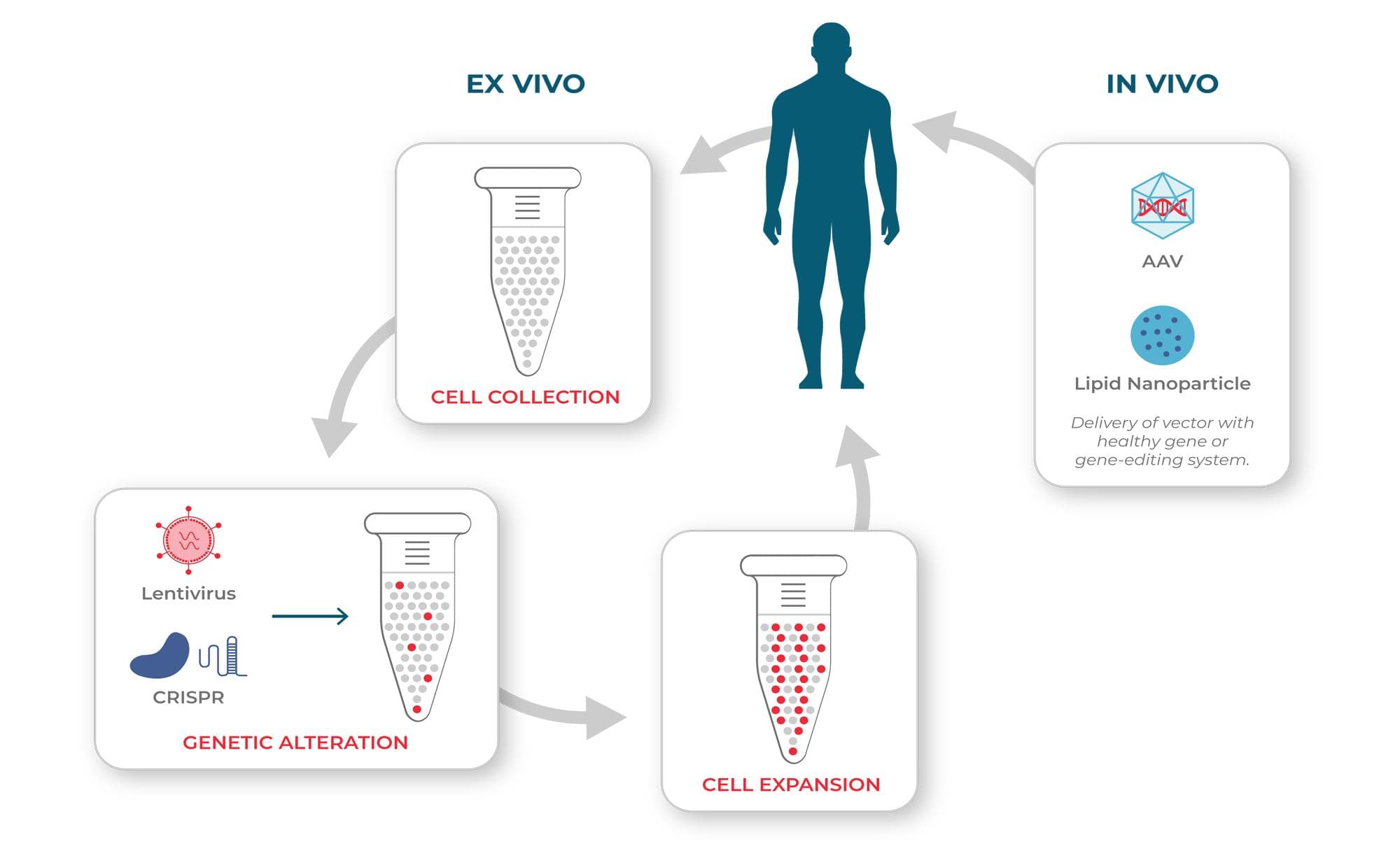
Ex vivo cell therapies (left) involve collecting cells from the patient or a donor. The cells may then be genetically modified before they are expanded and infused into the patient. In vivo gene therapies (right) are administered directly to the patient using a vector, such as adeno-associated virus (AAV) or lipid nanoparticles.
Measure Multiple Genotypic Attributes in a Single Assay
Genetic modifications during ex vivo cell therapy development are made to induce a therapeutic effect. Yet, these genetic alterations are not consistent across cells — some cells may contain the desired change, while others do not. Whether you are using viral integration of gene editing to alter DNA, Tapestri measures these modulations in thousands of individual cells per sample.
Similarly, Tapestri enables deeper analysis of in vivo gene therapies — such as cell-to-cell variability in the delivery of your vector within your target cells. With richer preclinical data, you can build a robust foundation for the clinical phases of your project.
Our multi-omics assays measure cell-surface markers as an additional layer of information so that you can track immunophenotype along with genotype in each cell.
Measuring Gene Transfer
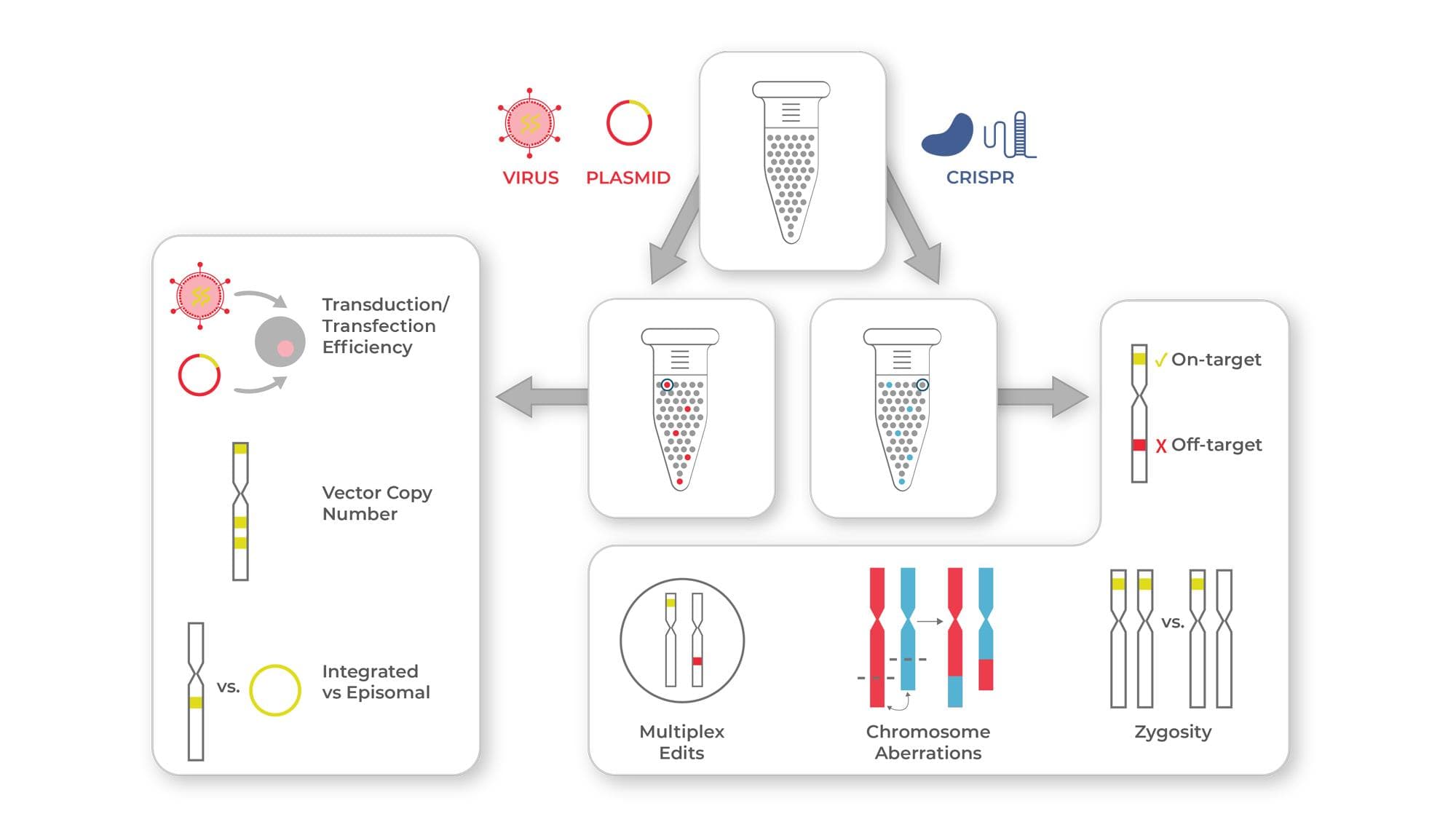
For cell therapies that have an introduced transgene, Tapestri can measure the transduction/transfection efficiency, vector copy number (VCN), and integrated vs. episomal DNA at single-cell resolution. Unlike bulk PCR assays that report population averages, Tapestri measures cell-to-cell variation in these attributes with no cell culture required.
Measuring Gene Editing
For therapies modified by CRISPR or other gene-editing tools, Tapestri can concomitantly measure on- and off-target editing in each cell. Additionally, multiplex editing, zygosity, and translocations can be assessed. In contrast to traditional bulk NGS analysis, Tapestri delivers data from individual cells so that you can understand cell-to-cell variability in your product.
Robust Characterization of Cell and Gene Therapies with Single-cell Analysis
Watch our video on Tapestri for Cell and Gene Therapies.
Partnering with Mission Bio
We are your strategic partner for advancing your gene and cell therapy development pipeline.
Our Pharma Assay Development team will help develop your custom assay — from experimental design and sample processing to data analysis and interpretation. We offer services internally or in partnership with qualified CROs and are invested in bringing more accurate characterization to your early discovery efforts and beyond. We are committed to helping you bring safe, efficacious, and successful therapies to patients faster.


“For the first time ever, we have created a transduction assay that delivers results in days, not months. And the results are incredibly reliable.”
Azadeh Golipour, PhD, AVROBIO

Partnered with Leading Institutions
Allogene
Avrobio
Bluebird Bio
Cellectis
CRISPR Therapeutics
CSL Behring
Genentech
Graphite Bio
Homology Medicines
Poseida
The Tapestri Platform
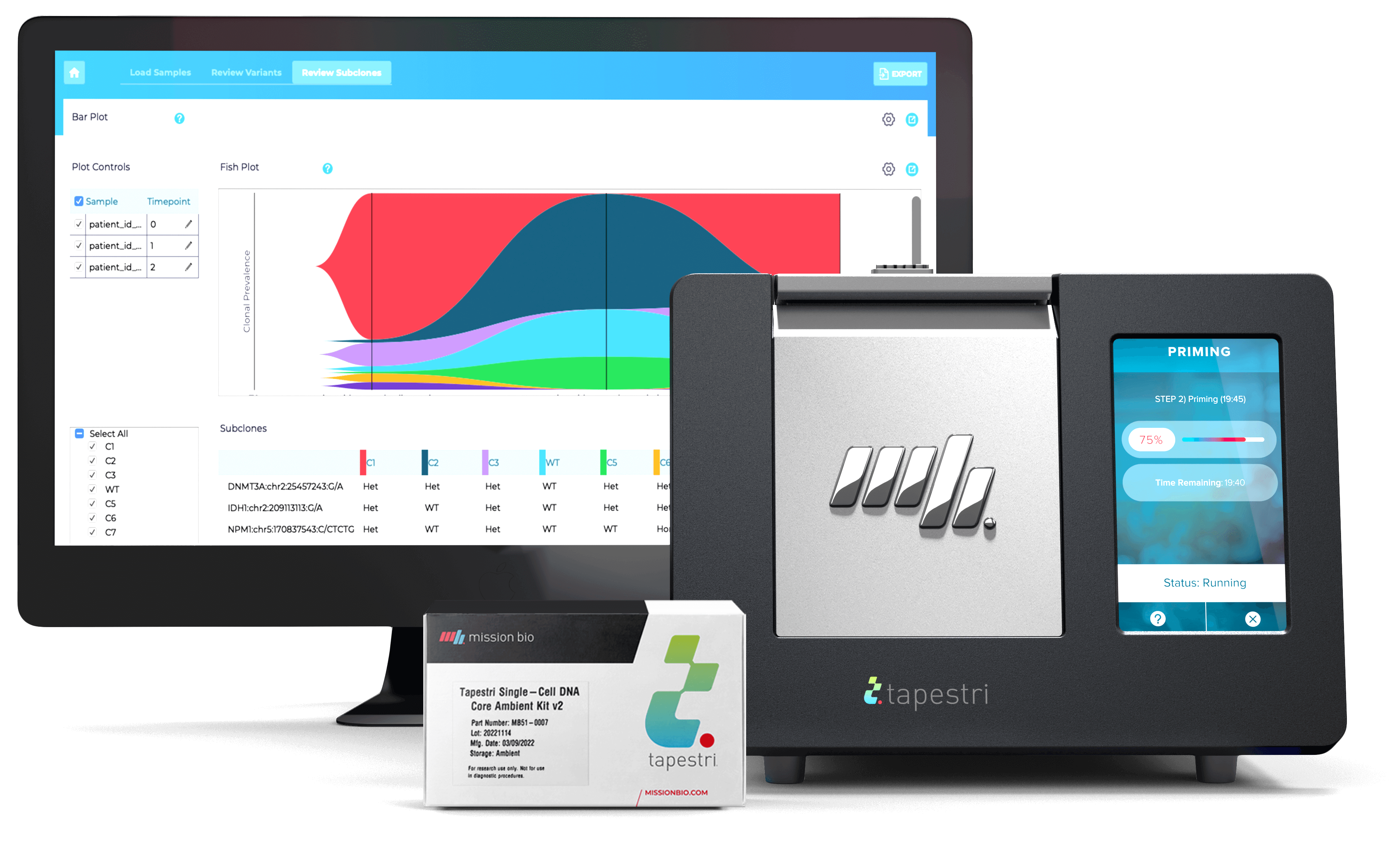
The Tapestri Platform
The first and only multi-omics platform developed to simultaneously measure genotype and immunophenotype at the single-cell level.
Pharma Assay Development
Mission Bio offers single-cell assay services using the Tapestri Platform to support your therapeutic pipeline — from experimental design to analysis and data interpretation.
Learn How Single Cell Is Enabling Advanced Therapeutics
Watch Yan Zhang present at Cell and Gene Meeting on the Mesa, 2021.
Explore the Data
The Tapestri Platform can be used to analyze a variety of genetic alterations at single-cell resolution. The following data illustrate the powerful ability of Tapestri to assess lentiviral transduction as well as on/off-target editing, multiplexed edits, zygosity, and translocations resulting from gene editing.
Vector Copy Number

The percentage of cells with different vector copy numbers (0-5) from a mixed sample run on Tapestri. The per-cell VCN was determined using a proprietary algorithm that was trained on cell lines with known numbers of vector copies. Link to poster
On/off-target Editing

In a gene-editing project with Agilent Technologies, 3 genes (HBB, CLTA, and RAB11A) were co-edited using CRISPR/Cas9 in a cancer cell line. Tapestri analysis detected on-target and predicted off-target editing (as % indels) for each target gene.
VIEW APP NOTE
Translocations

In a gene-editing project with Agilent Technologies, 3 genes (HBB, CLTA, and RAB11A) were co-edited using CRISPR/Cas9 in a cancer cell line. Tapestri analysis detected translocation events with high sensitivity (0.2-1.8% of cells).
VIEW APP NOTE
Multiplexed Edits & Zygosity

Tapestri was used to analyze a CRISPR multiplex editing experiment in which 3 loci were targeted simultaneously in PBMCs. Tapestri resolved the percentage of alleles edited, zygosity, and mutation co-occurrence in all 27 possible combinations.
Link to poster