
Analytical Development Challenges in Cell & Gene Therapy
Moving a cell and gene therapy toward the clinic means every cell is a potential liability. While your therapy may appear safe and effective on average, population level data from bulk cell & gene therapy assays can mask hidden threats.
A single-cell with an unintended off-target event, or an aberrant vector integration can have catastrophic consequences, leading to safety failures and costly clinical holds. To truly de-risk your cell and gene therapy program, you must move beyond bulk averages and identify every rare, potentially dangerous aspect of your cell and gene therapy before it negatively impacts a patient.
A rigorous analytical development and quality control process provides the critical data to characterize your cell and gene therapy, building a comprehensive product profile that ensures safety and de-risks your path to clinical success.
Custom, Fit-For-Purpose Cell & Gene Therapy Assay Development Services
To overcome the critical analytical hurdles during cell and gene therapy development, Mission Bio’s Cell and Gene Therapy Assays are developed through their Pharma Assay Development (PAD) services. These Cell and Gene Therapy Assay Development Services are a collaborative partnership with you to design, validate and deploy custom, fit-for-purpose single-cell analytical assays for your unique cell and gene therapy program needs, since we know your therapy deserves better.
Leveraging the Tapestri® platform, our Cell and Gene Therapy Assay Development Services provide you a single-cell multi-omics view to understand the complex attributes of your cell and gene therapy product with single-cell resolution – this means simultaneously measuring genotype, targeted gene expression, and phenotype all within the same cell. With this kind of resolution, the amount of data produced can be overwhelming but our bioinformatics experts simplify this data delivering definitive answers on the quality, safety, and efficacy of your therapy measured by these cell and gene therapy assays, giving you the confidence to characterize your therapy effectively throughout each phase of therapy development.
Our Cell and Gene Therapy Assay Development Services are structured in phases to deliver robust single-cell multiomic assays for your cell and gene therapy. This phase approach provides clear milestones, from the initial concepts of the cell and gene therapy assays to the final assay transfer for scaling and manufacturing of your cell and gene therapy at your preferred CRO or CDMO.
Table 1: Phases of Cell and Gene Therapy Pharma Assay Development services
PHASE 1: FIT FOR PURPOSE ASSESSMENT
- Sample: Control cell lines
- Includes client’s custom analyte panel
- Sample specific protocol development
- Initial analysis methods testing is conducted on a preliminary set of experiments to establish Tapestri for intended use
PHASE 2: PRELIMINARY ASSAY VALIDATION
- Sample: Experimental cell lines
- Intent is to confirm assay specificity, sensitivity, and linearity or establish robust validation assay
- Sample process optimization
- Possibility to expand across multiple drug products or lots
PHASE 3: TRANSFER GMP READY ASSAY TO CLIENT OR CDMO
- Tapestri instrument installation, premium training
- Operational and performance qualifications (IOQ/PQ)
- Lot-controlled customized product bundle for transfer and assay qualification
- Final transfer report
- Wet lab and sequencing procedures
- Cloud-hosted bioinformatics pipeline and user guide
- Formal documentation
How Can Single-Cell Resolution De-Risk Cell & Gene Therapy Assays?
Need to download a brochure to share with your team at your next group meeting? Access here.
With a custom cell and gene therapy assays that fits the needs of your cell and gene therapy pipeline, you can measure multiple DNA, RNA, and protein attributes simultaneously.
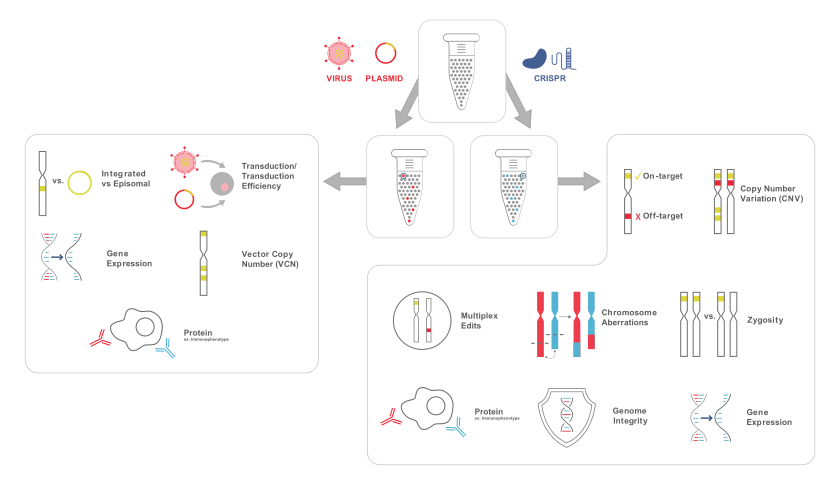
Figure 1: Possible attributes you can assess through our Cell and Gene Therapy Assay Development Services with single-cell high-resolution.
Table 2: Attribute considerations for developing a successful cell and gene therapy assay
Vector copy number (VCN)
Unlike bulk assays that report a misleading population average, our single-cell cell and gene therapy assays can quantify the precise number of vector copies in thousands of individual cells. This reveals the true distribution of your therapeutic dose, allowing you to identify and eliminate unsafe cell populations with dangerously high copy numbers or ineffective cells with none at all, providing a far more accurate measure of your therapy products potency and safety.
Integrated vs Episomal
Determine the durability and mechanism of your cell and gene therapy by distinguishing whether your vector is integrated into the host genome or exists transiently as episomal DNA. Our single-cell cell and gene therapy assays can be designed to provide this critical information, clarifying the long-term therapeutic potential and stability of your cell and gene therapy without the need for laborious cell culturing and cloning.
Multiplex edits
For a cell and gene therapy that requires multiplex gene edits using methods like CRISPR, confirming the complete editing profile in every cell is critical to understand the editing precision and efficacy. We enable you to verify the co-occurrence of all intended edits within each individual cell, ensuring your final product is composed of cells with the precise combination of modifications required for therapeutic success.
Chromosomal aberrations & Genome integrity
Go beyond small insertions or deletions (indel) analysis to monitor for larger structural variants and chromosomal rearrangements that can occur during gene editing. Maintaining genome integrity is a paramount safety concern, and our custom, fit-for-purpose cell and gene therapy assays provide a critical QC check to detect these rare but potentially hazardous events that are invisible to standard bulk approaches.
Zygosity
Resolve the exact nature of your gene edits by determining zygosity at the single-cell level. Understand whether your gene edits are resulting in heterozygous or homozygous modifications across both alleles, which directly impacts therapeutic dose, potency, genotoxicity, and functional outcome because the cell is oftentimes the therapeutic product.
On- and off-target editing
Gain a complete understanding of your CRISPR gene editing outcomes by simultaneously measuring both on-target and off-target events in the same cell of your cell and gene therapy. This unique capability allows you to assess the true risk-benefit profile: are cells with dangerous off-target edits also the ones with the desired therapeutic modifications? Answering this question is crucial for confidently selecting the safest and most effective candidates for your cell and gene therapy.
Targeted gene expression
Directly connect your CRISPR gene edits or modifications to their downstream functional gene expression. By adding targeted gene expression analysis to your cell and gene therapy assay, you can measure relevant gene expression changes in the very same cell you are analyzing for VCN or gene editing outcomes.
Our dedicated Cell and Gene Therapy Assay Development Services team partners with you to build the robust assays needed to fully characterize your therapy, providing the quantitative, single-cell insights required at each phase of development. To get started, talk to our dedicated scientists to start mapping out your custom, fit-for-purpose cell and gene therapy assays today.
In cell and gene therapy, the therapeutic product can be the cell itself, making analytical development uniquely complex. Unlike other therapy modalities where the product is molecularly defined, cell-based therapies consist of living, dynamic cell populations that can display significant heterogeneity in genotype, phenotype, and function. Without rigorous analytical development strategies, this variability can directly impact critical quality attributes including potency, persistence, and safety posing risks for both clinical efficacy and patient outcomes. Traditional bulk cell & gene therapy assays, which average measurements across a population, often obscure rare but consequential events such as unintended edits, clonal dominance, or loss of function. To overcome these limitations, analytical development strategies for cell and gene therapy require deep confirmation single-cell and multiomic approaches capable of precisely characterizing product heterogeneity, ensuring consistent manufacturing, and enabling accurate assessment of therapeutic potential.
A successful analytical development strategy moves beyond population bulk averages to deliver a deep confirmation, single-cell understanding of the cell & gene therapy. This level of granularity is essential for definitively linking a genetic modification to its functional outcome, providing unambiguous confirmation of product identity and mechanism of action. From a safety perspective, it enables the precise detection and quantification of outliers, such as cells harboring elevated vector copy numbers or unintended off-target edits, which are often masked in bulk cell and gene therapy assay analysis. This detailed characterization is the foundation for a robust potency assay, enabling developers to identify and quantify the specific cell subpopulations that drive therapeutic efficacy and correlate with the desired clinical performance.
Mission Bio’s Cell and Gene Therapy Assay Development Services bring this level of analytical development strategy into practice by partnering with developers to design and optimize fit-for-purpose assays designed for the unique requirements of their cell and gene therapy. With deep expertise in single-cell multiomic technologies, Mission Bio enables developers to directly connect genetic modifications with functional readouts, quantify product heterogeneity, and identify critical subpopulations that drive efficacy or pose safety risks. By integrating a robust analytical development strategy in early development phases, Mission Bio helps you de-risk clinical translation, establish cell and gene therapy assays that accurately reflect your therapy product performance, and build a scalable analytical framework that aligns with regulatory expectations. These strategies not only strengthen the precision and reproducibility of safety and potency assessments but also create a foundation that supports consistent manufacturing as your cell and gene therapy advance toward commercialization.
To deliver its full value, your custom cell and gene therapy assay must be scalable and transferable across all phases of your cell and gene therapy development. This means it must perform reliably both at your own site and within the facilities of your partnering Contract Research Organization (CRO) or Contract Development and Manufacturing Organization (CDMO). Our Cell and Gene Therapy Assay Development Services are designed to connect therapy development phases, from early-stage research to a transferable, GMP-ready assay that supports your long-term clinical and commercialization success. Our dedicated field team manages the complete Tapestri instrument installation and performs rigorous operational and performance qualifications at your site, CRO, or CDMO, that include hands-on training to ensure your scientists are fully equipped to execute your custom cell and gene therapy assays.
To ensure consistency across therapy development phases in your QC environment, we provide a lot-controlled, customized product bundle specifically for assay transfer and qualification. Upon completion, you will receive a comprehensive documentation package designed to support success in a regulated environment, with deliverables that can include:
- A final, detailed transfer report
- Step-by-step wet lab and sequencing procedures (SOPs)
- Access to a cloud-hosted bioinformatics pipeline with user guides
- All formal documentation required for your records that include installation and operation qualifications (IOQ), and process qualifications (PQ)
This assay transfer to your team, whether in-house at your site or with your CRO or CDMO, enables them to confidently execute your custom cell and gene therapy assays. It ensures consistent analytical characterization across therapy development phases, supporting your scale-up from early development through clinical translation and beyond.
De-risk Your Cell & Gene Therapy Program By Partnering With Us

Frequently Asked Questions
Using a custom cell and gene therapy assay that leverages single-cell multiomics, you can resolve rare contaminating cell types or identify unwanted off-targets at the individual cell level that bulk assays cannot. These custom cell and gene therapy assays provide deep confirmation of your final cell therapy product by combining genome evaluation with gene expression, surface maker identification, and clonal linage tracking at single-cell resolution.
Our cell and gene therapy assays can help you quantify vector copy number in thousands of individual cells, providing a direct measure of transduction efficiency and revealing the true dose distribution. This allows you to identify and eliminate unsafe cell populations with dangerously high copy numbers or ineffective cells with none at all, providing a far more accurate measure of your therapy product’s potency and safety.
We assess genomic safety by simultaneously measuring both the intended on-target edits and any unintended off-target edits within the same single cell. This approach provides the clearest view of the risk-benefit profile by directly answering the critical question: “Are the cells with potentially dangerous off-target edits the same ones that contain the desired therapeutic modification?”
We use single-cell multiomics to resolve the clonal architecture of the immune response by simultaneously sequencing TCR/BCR loci and quantifying surface protein expression. This directly links antigen-specific clonotypes to functional phenotypes, revealing whether vector-reactive T cells form short-term responses or establish long-term memory populations.
Bulk cell and gene therapy assays average results across a population and can mask rare but dangerous changes within the therapy product. Single-cell multiomics measures DNA, RNA, and protein in individual cells, revealing hidden risks like off-target edits, high vector copy numbers, or clonal dominance that directly affect safety and efficacy.
Every cell is a potential liability because in some cases, it is the therapy product. With custom cell and gene therapy assays that leverage single-cell multiomics, you can detect rare but critical safety issues such as chromosomal aberrations, unintended edits, or aberrant vector integrations before they derail clinical development. This helps avoid costly clinical milestone holds and strengthens regulatory submissions.
Custom cell and gene therapy assays that leverage single-cell multiomics should measure vector copy number (VCN), integrated vs. episomal status, multiplex edits, chromosomal integrity, zygosity, on/off-target editing, and targeted gene expression all at the single-cell level, providing a complete profile of therapeutic quality.
Unlike molecular drugs, the therapeutic product in cell and gene therapies can be the cell itself, a living heterogeneous population. Without rigorous analytical development, hidden variability threatens potency, persistence, and safety. Single-cell analytical strategies ensure rare but consequential events are identified and controlled.
Single-cell data directly links genetic modifications to functional readouts (e.g., gene expression changes or cell surface phenotype). This enables developers to pinpoint the exact subpopulations driving efficacy and build potency assays that truly understand therapeutic mechanisms of action.
Bulk cell and gene therapy assays may show “clean” averages, but single-cell assays reveal whether the same cells with therapeutic edits also carry unintended off-targets or structural variants. This adds a layer of genomic safety monitoring that regulators are increasingly prioritizing.
Mission Bio’s Cell and Gene Therapy Assay Development Services include full assay transfer to your site or CRO/CDMO, with Tapestri instrument installation, IOQ/PQ documentation, SOPs, bioinformatics support, and training. This ensures your custom assays are GMP-ready, reproducible, and consistent across all phases of therapy development.
Yes. Single-cell multiomics analysis from our custom cell and gene therapy assays reveals whether cellular composition, clonal diversity, and functional states remain consistent. This provides deeper evidence than bulk assays alone, supporting regulatory comparability requirements and de-risking manufacturing transitions.